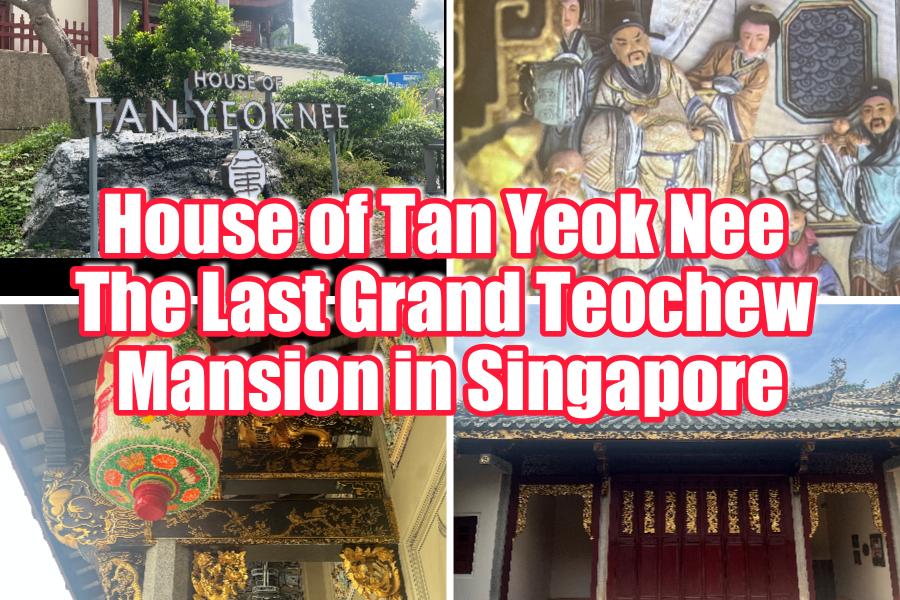


Walking along 101 Penang Road, just a short walk from Orchard Road, stands one of Singapore’s most remarkable heritage treasures – the House of Tan Yeok Nee (Where you always shop around in Johor Bahru Jalan Tan Hiok Nee? Yes. They are the same person 陈旭年). Surrounded by modern skyscrapers and busy city streets, this magnificent mansion offers a rare glimpse into the lives of Singapore’s early Chinese pioneers and the rich architectural traditions they brought from China. It is also the only surviving example of the famous “Four Grand Mansions” built by wealthy Teochew businessmen in the late 19th century.


A Mansion Built by a Teochew Pioneer
The mansion was built between 1882 and 1885 by Tan Yeok Nee, one of Singapore’s most successful Chinese entrepreneurs of the colonial era. Originally from Chaozhou in Guangdong Province, China, Tan arrived in Singapore as a humble textile peddler. Through determination and business acumen, he built a vast fortune from the pepper, gambier, opium and spirit trades, eventually becoming one of the wealthiest Teochew businessmen in Southeast Asia.


The house was constructed not only as a family residence but also as a symbol of success, status and cultural pride. Its location near Oxley Hill and the former Stamford Canal was believed to possess excellent feng shui, reflecting traditional Chinese beliefs in prosperity and harmony.
A Living Monument to Singapore’s Immigrant Story
More than just a beautiful building, the House of Tan Yeok Nee represents the contributions made by early Chinese immigrants to Singapore’s development. These pioneers helped transform Singapore from a small trading port into a thriving commercial centre.
The mansion serves as a reminder of how immigrants like Tan Yeok Nee contributed to the country’s economy, trade networks and community development. For this reason, it was gazetted as a National Monument on 19 November 1974, ensuring its preservation for future generations.

Surviving Wars and Changing Times
The building has witnessed more than 140 years of Singapore’s history.
After Tan Yeok Nee’s family moved out, the British administration acquired the estate. During the early 1900s, the nearby Tank Road Railway Station was built, and the house was used by railway officials. Later, it became Saint Mary’s Home and School under the Church of England.

In 1938, the mansion became the headquarters of the Salvation Army’s Malayan Command. During the Japanese Occupation, the building was seized and used as a storage facility. It suffered damage during the war and was later restored by the Salvation Army after World War II. The organisation remained there until 1991.
Architectural Masterpiece
The photographs below beautifully capture many of the mansion’s finest details:
- Intricate gold-painted wood carvings.
- Granite columns imported from China.
- Traditional Teochew roof ridges.
- Colourful porcelain mosaics known as qian ci (嵌瓷).
- Decorative guardian lions and mythical creatures.
- Open-air courtyards designed for ventilation and natural light.
One fascinating feature is the roof ornamentation made from broken porcelain pieces carefully cut and assembled into elaborate scenes of flowers, horses, birds and legendary figures. This craftsmanship is rarely seen today and required highly skilled artisans.


A New Chapter
Following extensive restoration works, the mansion reopened in 2025 as a heritage gallery and cultural venue. Today, visitors can admire its architecture, learn about Teochew heritage and appreciate one of Singapore’s finest surviving examples of traditional Chinese residential architecture.

Why This Building Matters
The House of Tan Yeok Nee is important because it tells several stories at once:
- The success of Singapore’s early immigrants.
- The contributions of the Teochew community.
- The evolution of Singapore through colonial rule, war and independence.
- The importance of preserving cultural heritage amid rapid urban development.
Standing in its quiet courtyard today, it is hard to imagine that this elegant mansion has survived railway construction, wartime occupation, redevelopment pressures and more than a century of change. Yet it remains one of Singapore’s most treasured architectural gems, connecting modern Singaporeans with a rich and fascinating past.


Address: 101 Penang Road, Singapore 238466
Nearest MRT: Dhoby Ghaut MRT Station
National Monument Since: 19 November 1974