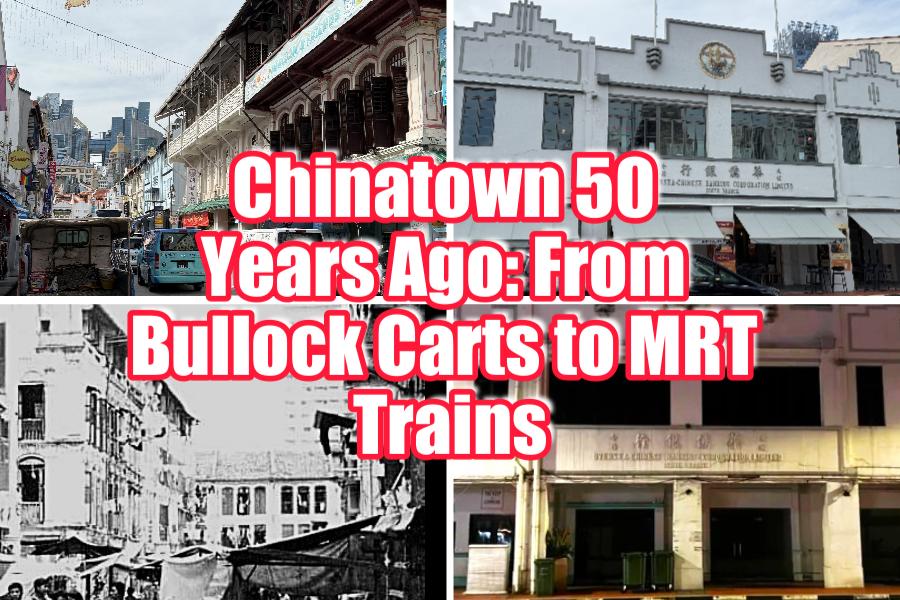
Visit Chinatown today and you may see tourists photographing shophouses, shoppers hunting for souvenirs and café customers deciding whether their iced latte looks photogenic enough.
Travel back around 50 years, however, and Chinatown was a completely different world. The streets were noisier, messier and much more crowded. Laundry hung outside upper-floor windows, hawkers squeezed along the roadside, and entire families lived in tiny rooms above shops. Air-conditioning was rare, personal space was a luxury, and finding a parking lot was probably the least of anyone’s worries.

Credit

Chinatown is also known as Kreta Ayer, meaning “water cart” in Malay, or Niu Che Shui 牛车水 in Chinese. Long before MRT trains carried thousands of commuters underground, bullock-drawn carts transported water through the neighbourhood.
Yes, Chinatown once had its own “public transport” system—powered by oxen. It was slower than the MRT, produced no announcements about train delays and occasionally left something unpleasant on the road.
As more Chinese immigrants settled here during the 19th and early 20th centuries, the district became packed with provision shops, medicine halls, clan associations, temples, street markets and entertainment venues. It was not designed as a tourist attraction. It was a working neighbourhood where people lived, traded, prayed, argued, ate and somehow managed to dry their laundry above the traffic.

Credit


Credit

Entertainment was serious business too. The grand Majestic Theatre, completed in 1927, first hosted Cantonese opera performances before becoming a popular cinema. Moviegoers once crowded beneath its ornate façade to catch the latest films. Today, the restored building still stands proudly—although the giant movie posters and queues have disappeared.

Credit

Meanwhile, the present Yue Hwa Chinese Products department store occupies the former Nam Tin Building. It was once home to the Great Southern Hotel, one of Chinatown’s most prestigious hotels. So technically, Yue Hwa did not replace the Majestic cinema—but both buildings show how old Chinatown landmarks have found new purposes.
Another conserved building along South Bridge Road once operated as an OCBC banking hall. Where customers previously discussed savings accounts and business loans, visitors can now check into accommodation. From banking money to booking rooms—that is quite a career change for one building.

Credit

From the 1960s onwards, residents were gradually rehoused, roadside hawkers moved into proper food centres and many shophouses were restored. Chinatown MRT station eventually opened in 2003, replacing the bullock cart with a much faster—and considerably less smelly—way to travel.

Credit


Today’s Chinatown may be cleaner, brighter and more tourist-friendly, but its old spirit remains inside the temples, theatres and shophouses. Look beyond the souvenir stalls and bubble tea shops, and you may still imagine the sound of hawkers calling, cinema crowds gathering and bullock carts slowly rolling through Kreta Ayer.