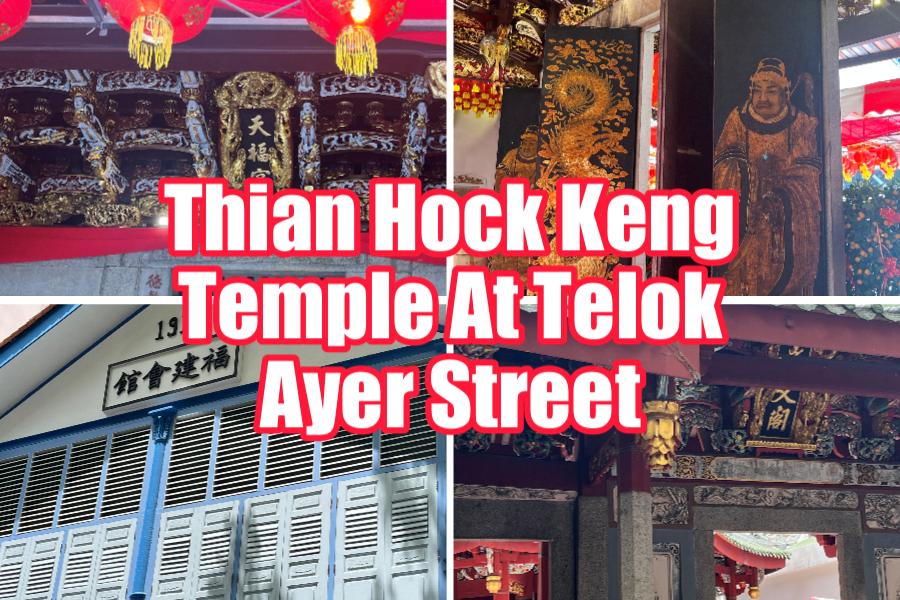
Nestled on Telok Ayer Street in Singapore’s historic Chinatown district, Thian Hock Keng Temple stands as a living testament to the island-state’s earliest Chinese settlers and their rich cultural legacy. This temple isn’t just a place of worship — it’s a symbol of courage, gratitude, and community continuity that has endured for more than 180 years.

From a Simple Shrine to a Sacred Sanctuary
The story of Thian Hock Keng begins not with grand architecture, but with humble faith. In the early 1820s, when Singapore was still a growing port under British colonial rule, Chinese immigrants — mostly Hokkiens from Fujian province — erected a simple prayer house along the shoreline of Telok Ayer Basin. Here, seafarers offered thanks to Mazu (also known as Tianhou), the beloved Chinese sea goddess they believed had protected them through treacherous sea voyages from southern China to the trading port.

As the settlement expanded and the Hokkien community grew, the need for a proper temple became clear. Between 1839 and 1842, funds collected from community contributions — notably from philanthropists such as Tan Tock Seng — were used to construct the substantial temple we see today. The materials, including stone columns, roof tiles and timber, were imported from China, and impressively, the entire structure was assembled without the use of nails, showcasing masterful craftsmanship rooted in traditional southern Chinese (Minnan) architecture.

Architectural Beauty and Spiritual Richness
Thian Hock Keng exemplifies classic southern Chinese temple architecture: sweeping curved roofs, elaborately carved beams, brightly painted ceramic ornamentation, and symbol-rich elements like dragons and phoenixes that speak to prosperity and protection.

Stepping through its entrance feels like stepping back in time. The central courtyard leads to the main shrine, where Mazu presides as the principal deity. Behind it, other altars honour figures from Buddhist, Taoist and Confucian traditions — reflecting a blend of beliefs that many Singaporean Chinese historically embraced.

A Community Hub, Not Just a Temple
Thian Hock Keng served functions beyond spirituality. Historically, it became a hub for the Hokkien community in Singapore. On its grounds in 1840, the Hokkien Huay Kuan — one of the earliest clan associations — was formed to support immigrants with accommodation, social welfare and education. In later decades, the site housed schools and became a meeting place where newcomers shared news, found work, and formed lifelong ties.

National Recognition and Restoration
Recognising its cultural and historical significance, Singapore gazetted Thian Hock Keng as a national monument in 1973, one of the earliest heritage sites to receive this designation.
In the late 1990s, the temple underwent a major restoration to preserve its original design and craftsmanship. The meticulous conservation work took two years and earned international recognition, including an honourable mention from the UNESCO Asia-Pacific Awards for Cultural Heritage Conservation — highlighting the temple’s importance not just to Singapore, but to architectural heritage in the region.

A Living Legacy in Modern Singapore
Today, Thian Hock Keng remains a vibrant space where worshippers still come to pray for blessings, tourists marvel at the artistry, and locals reflect on Singapore’s journey from a humble port town to a global city. Its presence on Telok Ayer Street, which once ran alongside the natural shoreline before land reclamation reshaped the coast, anchors the story of Singapore’s transformation — from sea-facing arrival point for voyagers to a bustling cultural crossroads.