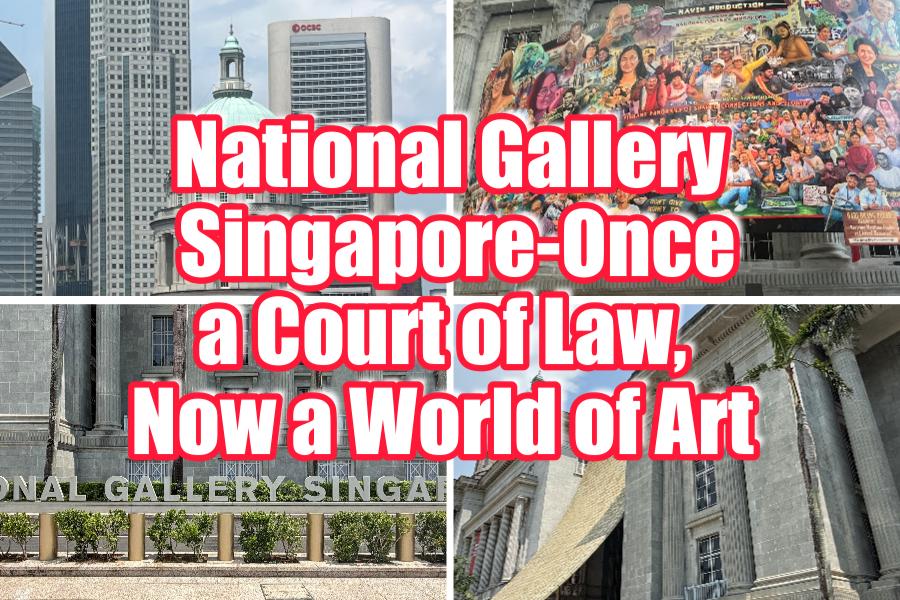
Standing proudly in the heart of the Civic District, National Gallery Singapore is more than just an art museum — it is a remarkable symbol of Singapore’s journey from colonial rule to a modern global city. Housed within two of Singapore’s most important historic buildings, the former Supreme Court and City Hall, the gallery beautifully blends history, architecture, and Southeast Asian art under one roof.


The idea of establishing the National Gallery Singapore was first announced in 2005, with the aim of creating a world-class visual arts institution dedicated to Southeast Asian art. After years of restoration and redevelopment works costing around S$530 million, the gallery officially opened its doors in November 2015. Today, it holds one of the world’s largest public collections of modern Southeast Asian art, with over 8,000 artworks from Singapore and the region.


The gallery occupies an enormous floor area of about 64,000 square metres, making it one of the largest visual arts venues in Singapore. The stunning architecture combines old colonial grandeur with modern glass-and-steel design elements. Visitors can admire elegant domes, towering Corinthian columns, spacious courtyards, and beautifully restored courtrooms that once played major roles in Singapore’s history.


The former City Hall building, completed in 1929 during British colonial rule, was once the administrative centre of the government. It was here that Admiral Lord Louis Mountbatten accepted the Japanese surrender in 1945 after World War II. Years later, in 1959, Singapore’s first Prime Minister, Lee Kuan Yew, stood on the steps of City Hall to announce Singapore’s self-governance.


Beside it stands the former Supreme Court building, completed in 1939. Designed by British architect Frank Dorrington Ward, the building was famous for its majestic green copper dome and luxurious interiors made with Italian marble. Before becoming part of the gallery, it served as Singapore’s highest court for decades.


The main purpose of the National Gallery Singapore is not only to preserve important artworks, but also to educate visitors about Southeast Asian culture, identity, and history through art. Through exhibitions, guided tours, workshops, and community programmes, the gallery helps both locals and tourists better understand the region’s rich artistic heritage.


Today, the National Gallery Singapore has become one of Singapore’s most iconic cultural landmarks. Beyond its impressive art collections, it stands as a living reminder of the nation’s colonial past, wartime struggles, independence journey, and cultural transformation into the vibrant Singapore we know today.