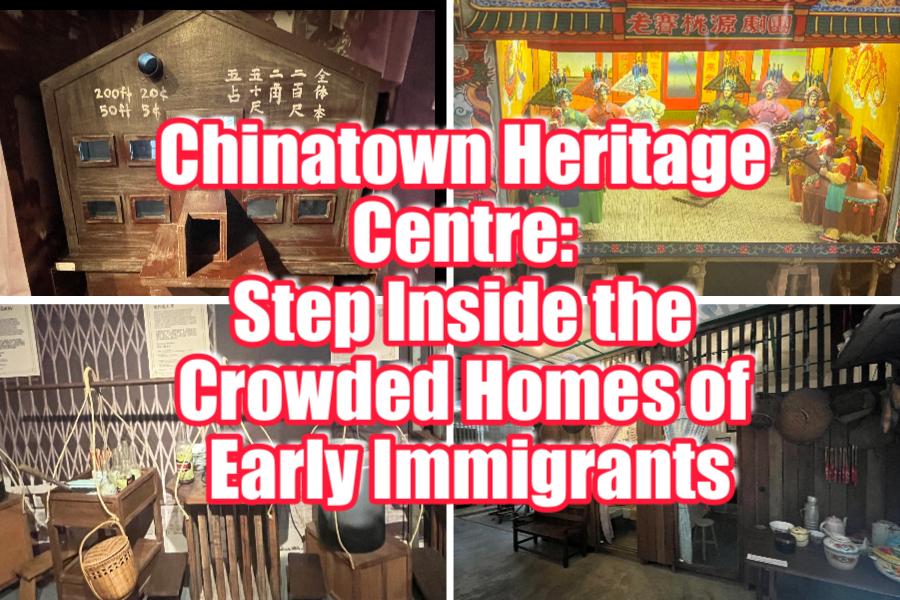

Walk through the doors of the Chinatown Heritage Centre and modern Singapore suddenly feels very far away. There are no spacious bedrooms, air-conditioning or walk-in wardrobes here. Instead, visitors enter a recreated world of narrow staircases, timber walls, shared kitchens and tiny rooms where several people once squeezed together under one roof.
Address : Chinatown Heritage Centre
📍 48 Pagoda Street, Singapore 059207
🚇 Nearest MRT: Chinatown MRT Station, Exit A — about 100 meters along Pagoda Street.


Located within restored shophouses along Pagoda Street, the centre traces the lives of Singapore’s early Chinese immigrants and the personal stories of those who made Chinatown their home. Shophouses were originally designed for both business and residential use, but as immigration increased, many became crowded shared dwellings occupied by working-class tenants.


Every corner of the exhibition reveals how little space each person had. Some tenants slept on simple wooden platforms or thin mats laid directly on the floor. Clothes were hung from bamboo poles above their heads, while baskets, cooking pots and personal belongings were packed tightly against the walls. Privacy was almost a luxury—sometimes a curtain was the only “door” separating one family from another.

The building was more than a home. It was also a workplace.
A tailor bent over a sewing machine, repairing shirts and making suits within a cramped room. A barber worked with basic razors, brushes and metal containers, serving customers from a simple chair. Traditional street barbers commonly operated along Chinatown’s five-foot ways and back lanes, turning almost any available corner into a workplace.


Elsewhere, food sellers prepared meals over charcoal stoves in a dark, smoky kitchen filled with woks, clay pots, chopping tools and woven baskets. Rickshaw pullers and construction labourers returned after long days of exhausting physical work, resting wherever there was enough room to stretch their legs.


Their lifestyle was simple because every cent mattered. Money was spent mainly on rent, basic food and essential supplies. New clothes, decorations and entertainment were rare treats rather than everyday expenses. When workers managed to save a little extra, much of it could be sent back to parents, wives or children in their hometowns in China.


The exhibits may look humble today, but they tell a powerful story. These immigrants arrived with few possessions and uncertain futures, yet they worked, saved and supported one another. By the turn of the 20th century, overcrowding had become common throughout Chinatown; many residents were eventually relocated to newer housing estates during Singapore’s urban renewal years.

The Chinatown Heritage Centre is therefore not simply a collection of old furniture. It is a doorway into the sacrifices, struggles and quiet determination that helped build modern Singapore.