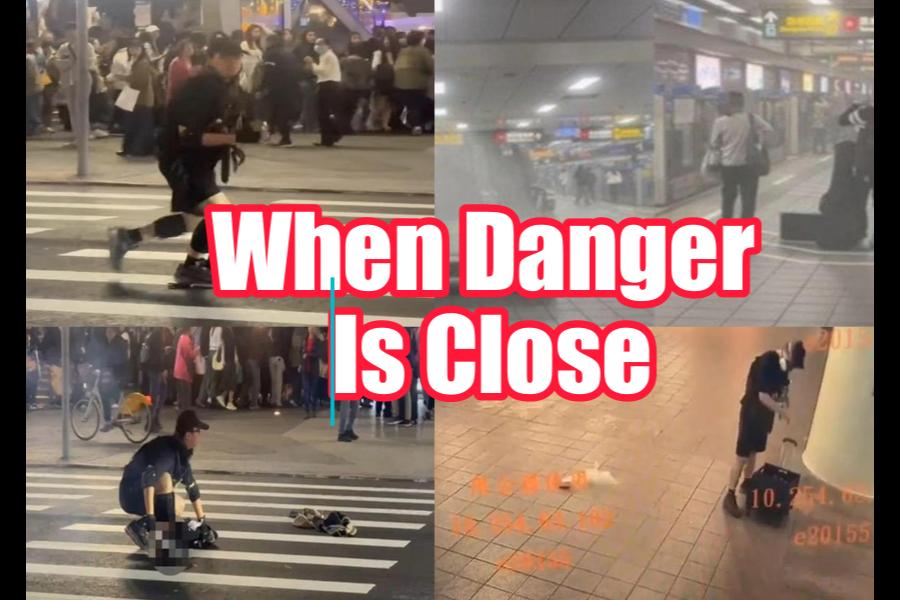
When danger suddenly appears and crisis surrounds us, how should we respond?
On the night of the 19th, the suspect spent over three hours moving across different districts on foot, carrying out a series of violent acts — from setting fires on the street, throwing smoke bombs in MRT stations, to attacking people with a knife inside Eslite Nanxi. At one point, he even returned to his hotel to change equipment before heading out again, acting with disturbing calm and deliberation.

The suspect, only 27 years old, was seen kneeling in the middle of a busy pedestrian crossing in the Zhongshan area, throwing smoke bombs as if following a script. He made no attempt to hide his face. Dressed in black, holding a long knife openly, his cold and composed expression sent chills through onlookers. Some people panicked, others froze — many had no time to react before tragedy struck again.

When the attacker entered Elite Nanxi, the space was instantly thrown into chaos. Yet amid fear, there were moments of quiet courage.

According to witnesses, Elite staff, supervisors, and restaurant employees remained calm under extreme stress. They quickly guided customers into fitting rooms, storage areas, and stairwells. Those hiding reminded one another to stay silent, showing remarkable restraint and cooperation despite their fear.

These ordinary yet crucial acts of responsibility and crisis management helped minimize harm and brought a sense of order to a terrifying situation.

However, this major indiscriminate attack also exposed serious gaps in public safety. Over several hours and multiple locations, why was the response unable to stop further harm? With smoke, panic, and surveillance footage clearly capturing events, why was intervention delayed? Does this suggest a lack of real-time monitoring or coordination?


When the initial attack occurred and the suspect was still at large, were nearby communities adequately informed? Could emergency alert systems have played a stronger role?
One image from the released footage remains deeply unsettling. A young woman, appearing to be a student, ran past the suspect carrying a backpack and a musical instrument. Seconds later, smoke bombs and incendiary devices were thrown exactly where she had just been. She did not hesitate — instinctively moving forward and away. Her distance from disaster was only a single step.

Elsewhere, others stood frozen in smoke, unsure of what was happening. In moments like these, the ability to recognise danger and act immediately can mean the difference between life and death.
Most heartbreaking was a 57-year-old man who stepped forward at Taipei Main Station to stop the attacker and lost his life. His courage deserves the highest respect, but his death also reminds us that society should not rely on individual sacrifice to compensate for systemic safety failures.

We can never predict when or where danger will appear. In an uncertain world, crisis awareness, self-protection, trusting one’s instincts, and moving away from danger quickly are no longer optional — they are essential survival skills.
We mourn the lives lost and are grateful for those who survived.
May this painful warning remain etched in our collective memory.