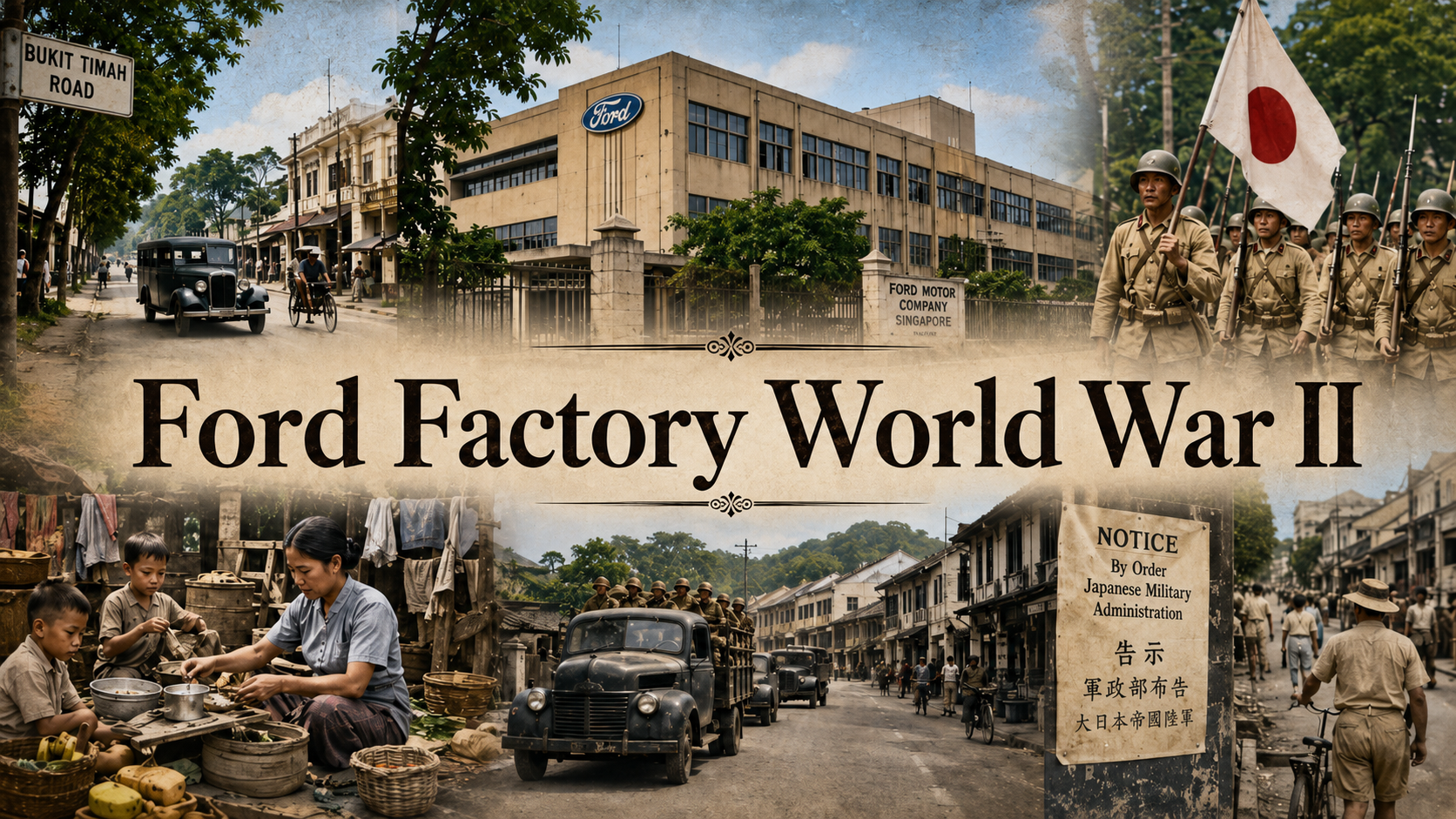
Standing along Upper Bukit Timah Road, the Former Ford Factory is more than an old industrial building. It is one of Singapore’s most important Second World War landmarks and the place where British rule suffered its most dramatic defeat in Southeast Asia.
Related Link: Bukit Timah Railway Station: Singapore Rail Heritage, Bukit Timah Interim Market: 15 Must-Try Hawker Stalls, Bukit Timah’s Hidden Waterfall Trail, Beauty World Food Centre Food Guide 13 Best Hawker Stalls, Beo Crescent Market & Food Centre: 10 Must-Try Hawker Stalls,

Completed in 1941, the Art Deco building was Ford Motor Company’s first automobile assembly plant in Southeast Asia. Production stopped when Japanese forces invaded Malaya, and the factory was subsequently used as the Japanese military’s headquarters. On 15 February 1942, British commander Lieutenant-General Arthur Percival met Lieutenant-General Tomoyuki Yamashita inside the factory’s boardroom and signed Singapore’s unconditional surrender. This marked the beginning of three years and seven months of Japanese Occupation.


Singapore was renamed Syonan-to, meaning “Light of the South”, but life for ordinary residents was anything but bright. Food, medicine, clothing and other necessities became increasingly scarce. Families survived on limited rations, grew vegetables and reused whatever materials they could find. Japanese-issued currency, nicknamed “banana money”, rapidly lost its value, making basic goods extremely expensive.


The island’s population had fallen to approximately 855,679 by 1943, before rising to about 940,824 in 1947. After the war, overcrowding, poor sanitation, malnutrition and shortages of hospital beds remained serious problems. Many residents lived in cramped houses or shared rooms with several families while Singapore struggled to rebuild.
Fear was also a constant part of wartime life. During the Sook Ching operation, Chinese men were ordered to report to screening centres only days after the British surrender. The Japanese authorities claimed they were identifying people involved in anti-Japanese activities, but the selection process was often inconsistent and arbitrary. Those suspected of resistance could be detained, interrogated or killed.


People accused of breaking military rules could face imprisonment, physical punishment or severe interrogation. Prisoners of war and civilian internees endured hunger, disease, overcrowding and forced labour. Despite these hardships, Singaporeans found ways to survive—sharing food, helping neighbours, secretly listening to overseas broadcasts and supporting prisoners despite the risk of punishment.

Today, the Former Ford Factory preserves personal accounts, photographs, documents and wartime artefacts from this painful period. Gazetted as a National Monument in 2006, it reminds visitors that Singapore’s peace and security were achieved through tremendous sacrifice—and should never be taken for granted.
Address : 351 Upper Bukit Timah Road, Singapore 588192
Nearby places : Hillview MRT, Bukit Timah, Rail Mall and Beauty World