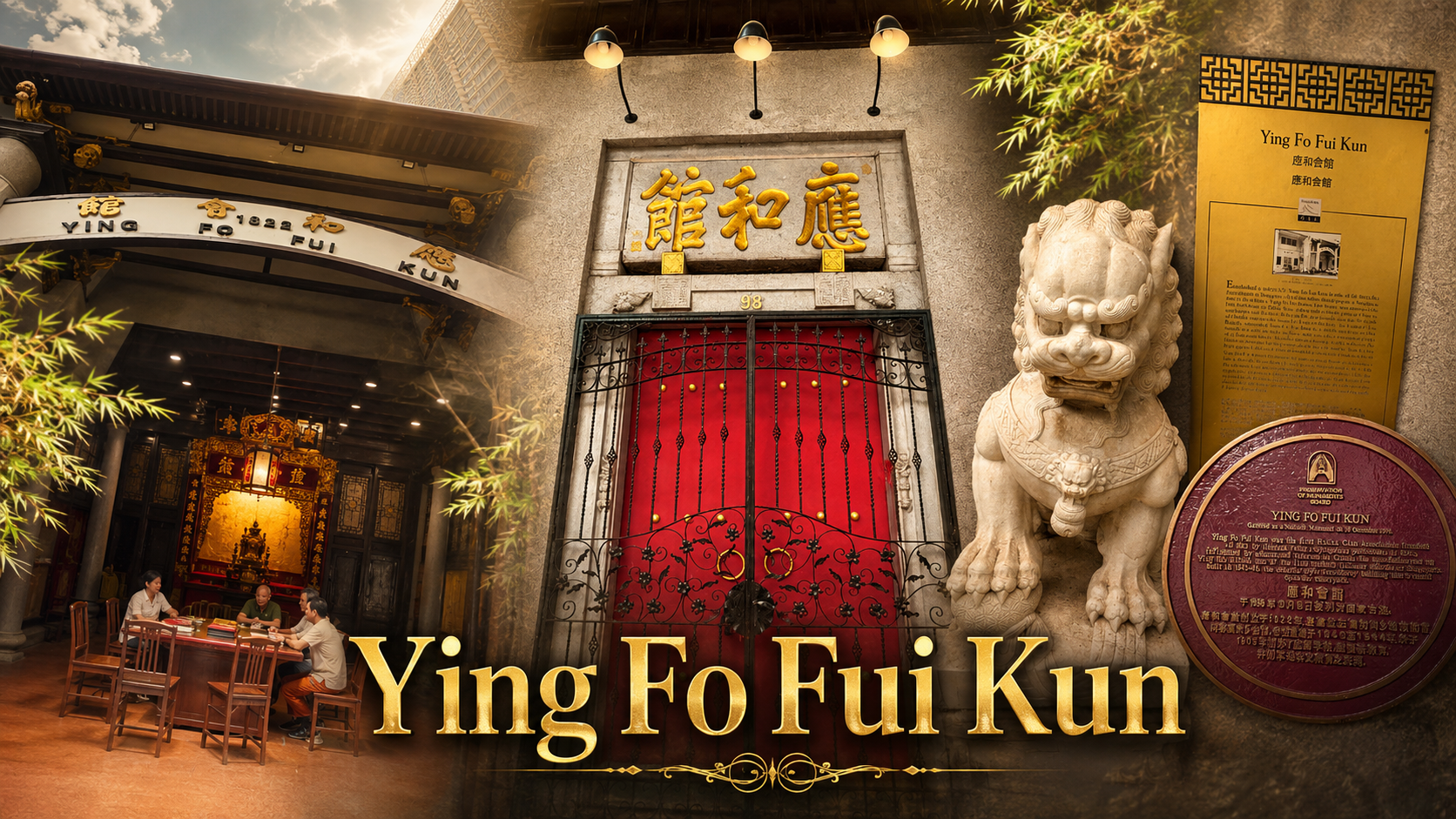
Walk along Telok Ayer Street before reaching Amoy Food Centre, it is easy to have your attention stolen by the gleaming office towers surrounding the area. But sitting quietly at 98 Telok Ayer Street is a much older resident — Ying Fo Fui Kun (应和会馆), Singapore’s oldest Hakka clan association.
Related Links: Thian Hock Keng Temple: Telok Ayer Heritage Landmark, Fuk Tak Chi Museum, Singapore, 25 Must-Try Hawker Stalls at Amoy Street Food Centre, Sky Garden at CapitaSpring, Singapore, 13 Must-Try Hawker Stalls at Market Street Hawker Centre.

And this building has been looking after people for more than two centuries.
Ying Fo Fui Kun was established in 1822, just three years after the British trading post was founded in Singapore. It was started by a group of Hakka clansmen led by Liew Lok Teck (刘润德), mainly serving immigrants whose ancestral homes were in five counties of Guangdong: Meixian, Xingning, Wuhua, Pingyuan and Jiaoling.

Back then, arriving in Singapore was very different from stepping out of Changi Airport with Google Maps and a hotel reservation. Many immigrants arrived after long sea journeys with little money, few contacts and no guaranteed job.
That was where Ying Fo Fui Kun came in.

The association helped newly arrived Hakkas find temporary accommodation and employment, while also providing a familiar community far away from home. Many early Hakkas worked as carpenters and woodcutters, while others became blacksmiths and goldsmiths. The association also helped ensure that members received proper funeral and burial rites — an important responsibility in those days.

In other words, you could think of Ying Fo Fui Kun as an early community centre, employment agency, welfare organisation and social network rolled into one.
Its role did not stop there. In 1905, the association established Ying Xin School (应新学校) inside the building. At a time when access to government education was limited for children who did not know English, the school provided education for children within the Chinese community. It continued operating here until around 1970.

The building itself contains some fascinating details. Its design follows traditional clan-and-temple architecture from Guangdong, centred around an internal courtyard. Look closely at the front and you may notice the windows are unusually high — a feature associated with defensive Hakka architecture, making it harder for unwanted visitors to climb inside.

Inside is also an altar dedicated to Guan Sheng Di Jun, better known as Guan Yu, who is admired particularly for loyalty — a rather appropriate figure for a building created around kinship and mutual support.
Ying Fo Fui Kun was gazetted as a National Monument on 18 December 1998, ensuring that this little pocket of Hakka history survives amid Singapore’s rapidly changing CBD.
Today, it remains the home of the association, which continues organising gatherings and activities promoting Hakka culture and heritage.

So the next time you pass this rather understated grey building on Telok Ayer Street, don’t dismiss it as just another old clan house. For generations of Hakka immigrants, this was once the place where a new life in Singapore could begin.
Nearest MRT: Telok Ayer MRT (DT18) — about 2–3 minutes’ walk